Coming to JIHE 2026 from abroad
Welcome. This page gathers the practical things worth knowing before you travel: how the three days are laid out, how to reach the venue from either airport, how to request a visa invitation letter, what you may and may not bring into Japan, and what is worth seeing while you are here.
This page is written for people traveling to JIHE 2026 from outside Japan.
Last updated: September 2, 2026
- Dates
- BUSINESS DAYFriday, November 13, 2026
- COMMUNITY DAYSaturday, November 14, 2026
- Venue
- House of OMOTESANDO, 5-34-8 Jingumae, Shibuya-ku, Tokyo
- Admission
- Free, with advance registration
Quick access
The six links you are most likely to need.
Contents
Event overview
JIHE, the Japan International Hemp Expo, brings together the companies, researchers, regulators, and curious newcomers who make up the hemp and CBD industry. In 2026 it runs for two days at House of OMOTESANDO in Tokyo.
- Dates
- BUSINESS DAYFriday, November 13, 2026
- COMMUNITY DAYSaturday, November 14, 2026 (with retail sales)
Setup day: Thursday, November 12 — AIHF International Consultation and the pre-event party for participants
- Admission
- Free, with advance registration
- Organizer
- Asabis Inc.
- Co-organizer
- GREEN ZONE JAPAN
- Supported by
- AIHF (Asia International Hemp Federation)
- Conference
- CannaCon, held on both days. There is no human simultaneous interpretation; sessions are interpreted by AI and shown as subtitles.
- Hashtag
- #jihe2026
The event uses four floors of the venue.
Floor / Use
- RFRooftop
- 2F White HallConference; the networking party and bar counter in the evening
- 1F LoungeReception, lounge, and meeting space
- B1F Sky HallExhibition booths and stage
There is only one entrance, on the first floor. Inside, you move between floors by stairs or a small elevator. If you need assistance, please ask at the 1F reception.
The three days
Here is how the three days fit together, including the day before. Doors open at 10:30 on both event days; the venue closes at 22:00 on Friday, November 13 and at 18:00 on Saturday, November 14.
November 12 (Thu)
Day before- All daySet-up and move-in (exhibitors receive their individual time slots separately)
- 13:00-17:30 approx.AIHF International Consultation
- From around 18:30Reception for exhibitors, sponsors, speakers, partners, and staff (JPY 1,000; free for speakers)
- 22:00Venue closes
November 13 (Fri)
BUSINESS DAY- 10:30Doors open (reception opening time TBA)
- From 10:30Exhibition (B1F), CannaCon conference (2F), meetings (1F)
- TBAExhibition closes; 2F White Hall is turned over for the networking party
- From around 18:30Networking Party (2F White Hall; JPY 5,000; 100 places; free for speakers)
- 22:00Venue closes
November 14 (Sat)
COMMUNITY DAY- 10:30Doors open (reception opening time TBA)
- From 10:30Exhibition (B1F), retail sales, CannaCon conference (2F)
- 18:00Venue closes
- 18:00-22:00Move-out for participating companies, to be completed by 22:00
The exhibition end time (when the 2F turnover begins) and the reception opening time are still being confirmed. The detailed session timetable will be published on the official site once it is fixed.
Getting to Tokyo and the venue
Most international flights land at Narita or Haneda. Both connect to the Omotesando area by train, bus, or taxi. The times below are rough guides only - allow extra time in the morning and evening rush.
From Narita Airport (NRT)
- By train≈80–90 min
- The Narita Express (N'EX) runs directly to Shibuya and Shinjuku in roughly 80 to 90 minutes. From Shibuya, Omotesando is one stop on the Tokyo Metro Ginza or Hanzomon line. The Keisei Skyliner is a faster alternative into Nippori and Ueno, but needs a further transfer.
- By bus≈90–120 min
- Airport limousine buses run to major hotels in Shibuya and Shinjuku, taking roughly 90 to 120 minutes depending on traffic. Convenient if you have large luggage, since you stay with your bags the whole way.
- By taxi≈90 min+
- Roughly 90 minutes or more depending on traffic, and considerably more expensive than the train. Worth it mainly for late arrivals or large groups.
From Haneda Airport (HND)
- By train≈45 min
- The Keikyu line to Shinagawa, then the JR Yamanote line to Shibuya, takes roughly 45 minutes in total. The Tokyo Monorail to Hamamatsucho is a similar alternative. From Shibuya, Omotesando is one stop by subway.
- By bus≈40–70 min
- Airport limousine buses reach Shibuya and Shinjuku in roughly 40 to 70 minutes depending on traffic.
- By taxi≈40 min
- Roughly 40 minutes outside rush hour. Haneda is much closer to central Tokyo than Narita, so a taxi is a more reasonable option here.
Getting around once you are here
- IC cards
- A rechargeable IC card is the simplest way to travel. Welcome Suica, sold at the airports and aimed at visitors, needs no deposit and works on trains, subways, and buses. You can also add Suica to Apple Wallet on an iPhone or Apple Watch and top it up with an overseas card, which saves queuing at a machine.
- The venue
- House of OMOTESANDO is about 10 minutes on foot from Omote-sando Station Exit B2 (Tokyo Metro Ginza / Chiyoda / Hanzomon lines) and about 6 minutes from Shibuya Station Exit B1; also walkable from Meiji-jingumae〈Harajuku〉, JR Harajuku, and JR Shibuya stations. The entrance is on the north-east side of the building.
- Address
- 5-34-8 Jingumae, Shibuya-ku, Tokyo 150-0001, Japan. Showing the Japanese address to a taxi driver is the most reliable way to arrive.
Map from the stations to the venue
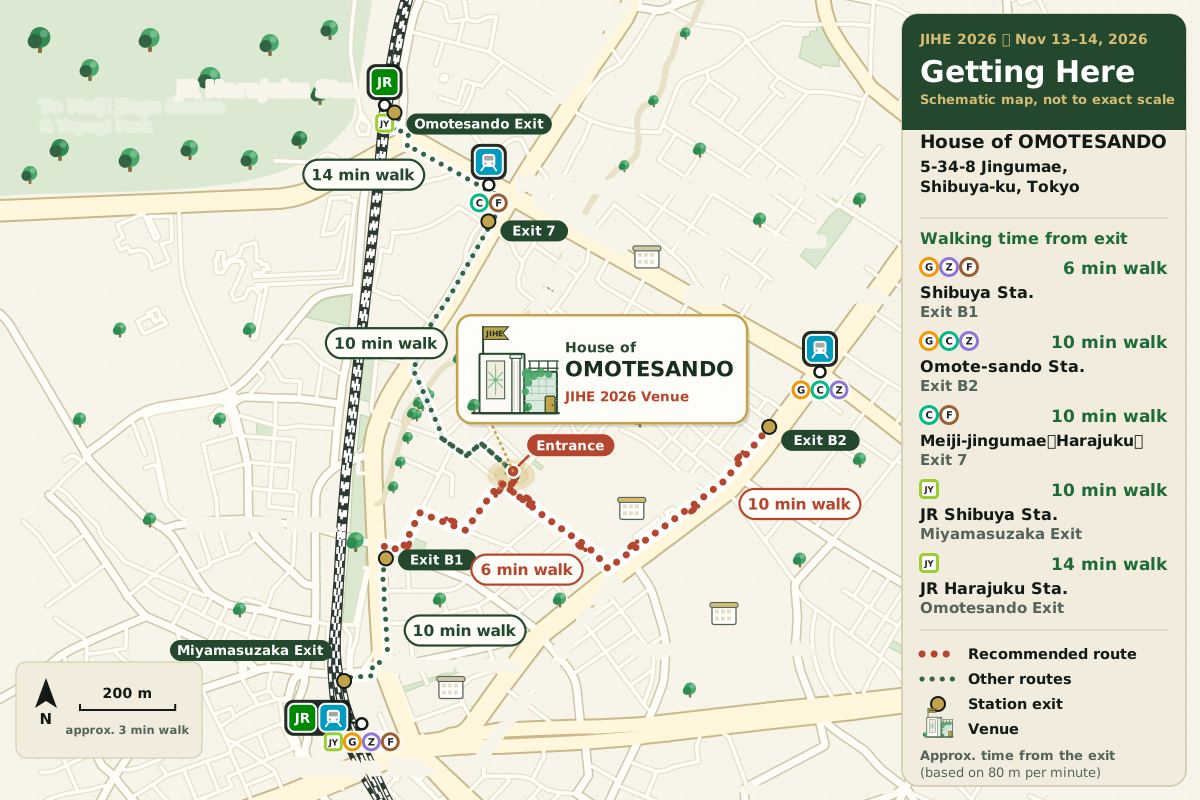
Shibuya Sta.Recommended
Exit B1
6 min walk
Omote-sando Sta. (Tokyo Metro Ginza / Chiyoda / Hanzomon lines)Recommended
Exit B2
10 min walk
Meiji-jingumae〈Harajuku〉Sta. (Tokyo Metro Chiyoda / Fukutoshin lines)
Exit 7
10 min walk
JR Shibuya Sta. (Yamanote line and others)
Miyamasuzaka Exit
10 min walk
JR Harajuku Sta. (Yamanote line)
Omotesando Exit
14 min walk
The entrance is on the north-east side of the building (top right on the map). Whichever station you come from, you reach it from the street on the north-east side.
Walking times are approximate, measured from each station exit at street level (80 m per minute).
- There is only one entrance, on the first floor. Inside, you move between floors by stairs or a small elevator.
- If you are bringing a stroller or using a wheelchair, please speak to the 1F reception and a staff member will assist you.
- Whether a cloakroom will be available is still being confirmed. We recommend traveling light, and leaving large luggage at your hotel or in a station coin locker.
- There is no parking at the venue. We recommend coming by public transport or taxi. If you do drive, please use a paid parking lot nearby.
Where to stay
How to choose an area to stay in. The venue is served by three stations - Omotesando, Meiji-Jingumae 'Harajuku', and Shibuya. If your hotel is somewhere you can reach one of those three without changing trains, your mornings become much easier. We don't recommend individual hotels, but see the reasonable hotel chains listed below.
The Networking Party on Friday, November 13 starts around 18:30 and the venue closes at 22:00. If you are joining it, getting back out of Tokyo the same evening will be difficult. Plan to stay the night before, the night after, or both.
A. Within walking distance - the most convenient
Omotesando, Harajuku, Aoyama, and Shibuya. Room rates are higher here, but you skip the commute entirely and can walk home after the networking party. Being able to drop your bags off mid-day is a real advantage over two long days.
B. Areas with no train change
If you would rather not pay for the immediate area, choose a line that reaches one of the three stations directly. These are the main destinations you can reach without changing trains.
| Station | Line | Reachable without changing trains |
|---|---|---|
| Omotesando | Tokyo Metro Ginza line | Akasaka-mitsukeGinzaShimbashiUenoAsakusa |
| Tokyo Metro Chiyoda line | Yoyogi-UeharaAkasakaHibiyaKita-Senju | |
| Tokyo Metro Hanzomon line | NagatachoOtemachiKinshichoOshiage (for Tokyo Skytree) | |
| Shibuya | JR Yamanote line | ShinjukuIkebukuroEbisuMeguroShinagawa |
| JR Saikyo line / Shonan-Shinjuku line | ShinjukuIkebukuroOmiyaYokohama | |
| Tokyu Toyoko line | NakameguroJiyugaokaMusashi-KosugiYokohama | |
| Tokyu Den-en-toshi line | SangenjayaFutako-Tamagawa | |
| Keio Inokashira line | ShimokitazawaKichijoji | |
| Tokyo Metro Fukutoshin line | Shinjuku-sanchomeIkebukuro | |
| Meiji-Jingumae 'Harajuku' | Tokyo Metro Fukutoshin line | Shinjuku-sanchomeIkebukuro |
| Tokyo Metro Chiyoda line | Yoyogi-UeharaAkasaka | |
| JR Harajuku | JR Yamanote line | ShinjukuIkebukuro |
Choosing between them
- Arriving by Shinkansen
- Stay near Tokyo Station or Shinagawa. Shinagawa reaches Shibuya directly on the JR Yamanote line.
- Arriving by air
- From Haneda, the Shinagawa and Hamamatsucho areas connect smoothly. From Narita, Ueno and Nippori do.
- Keeping costs down
- Ikebukuro, Ueno, Asakusa, Kinshicho, and Kita-Senju are all reachable without a change, and offer a far wider range of room types and prices than the immediate area.
Reasonable hotel chains
If you'd rather not compare dozens of hotels, these nationwide business-hotel chains offer dependable, reasonably priced rooms across central Tokyo. Search each chain for locations along the lines above.
APA Hotel
Nationwide business-hotel chain with many locations in central Tokyo.
Toyoko Inn
Nationwide business-hotel chain with many locations in central Tokyo.
Dormy Inn
Nationwide business-hotel chain with many locations in central Tokyo.
Super Hotel
Nationwide business-hotel chain with many locations in central Tokyo.
Sotetsu Fresa Inn
Nationwide business-hotel chain with many locations in central Tokyo.
Comfort Hotel
Nationwide business-hotel chain with many locations in central Tokyo.
Listed for convenience only; JIHE has no affiliation with these chains. Please book directly.
C. Consider a short-term rental
Hotel rates have risen sharply in recent years, and mid-November is a busy period in Tokyo. If hotels are scarce or the rates do not work for you, a short-term rental through Airbnb or similar is a genuine alternative - particularly if you are traveling as a group or staying several nights.
- Choose a listing that displays its minpaku (short-term rental) registration number. It is the clearest sign that the property is operating legally.
- Check how you get in - key handover or self check-in - and any rules on curfews and rubbish disposal, before you book.
- Look up the walk from the nearest station, and how you would get back if you miss the last train.
- Favor hosts with a large number of reviews. It is the simplest way to avoid problems on arrival.
D. Before you book
- November is peak season in Tokyo and rooms go early. Even before your plans are final, it is worth holding something on a free-cancellation rate.
- If you are coming to the Networking Party on Friday, November 13, plan on staying the night - the venue closes at 22:00 that evening, and last trains vary by line and direction, so check yours in advance.
- The streets around the venue are hilly and have a lot of steps. Leave your suitcase at your accommodation before coming over.
- November in Tokyo runs roughly 10 to 17 degrees Celsius - pleasant by day, cold in the evening. A light coat and layers are about right.
On the day
A few things we ask of everyone during the event.
- Check-in
- Check in on the first floor and collect your name badge. The reception opening time is still being confirmed.
- Re-entry
- You may re-enter at any time by showing your name badge.
- Busy periods
- Because there is only one entrance, you may be asked to wait when the venue is busy. Arriving outside peak times helps everyone.
- Food and drink
- No cooking takes place inside the venue. Please eat and drink in the designated areas.
- Photos and social media
- Please share your experience with #jihe2026. Where signage asks you not to photograph or record, please follow it.
- Filming at the venue
- The organizer, exhibitors, and media film and stream inside the venue. Photographs and video may be used for promotional purposes.
- Language
- Staff at the 1F reception can help in English. Conference sessions are interpreted by AI and shown as subtitles.
- Lost property and first aid
- Please go to the help desk at the 1F reception.
- Wi-Fi
- Venue Wi-Fi is limited. We recommend arranging your own mobile connection.
Networking and Community Events
The greatest value of JIHE is the people you meet. There are two receptions during the event.
- November 12 (Thu), from around 18:30
Reception for those involved
- Who can attend
- Exhibitors, sponsors, speakers, partners, and staff
- Fee
- JPY 1,000 (free for speakers)
- November 13 (Fri), from around 18:30
Networking Party
- Who can attend
- Open to everyone (100 places)
- Fee
- JPY 5,000 (free for speakers)
Both take place in the 2F White Hall, at the bar counter. The venue closes at 22:00 on Thursday, November 12 and on Friday, November 13.
For the Networking Party you can pay in advance through Peatix, or pay on the day. If you signed up through English registration, we confirm your intention in the registration questions and you pay on the day.
The cancellation policy, what happens once the 100 places are taken, and the payment methods accepted on the day are still being confirmed.
Visa invitation letter
Invitation letters were previously issued free of charge. As request volumes and the related administrative work have increased, general attendees requesting a letter are now asked to purchase a JIHE 2026 Networking Party ticket (JPY 5,000 per applicant). No separate invitation letter fee is charged.
Updated 28 September 2026 (Japan time). The updated policy also applies to earlier requests that we have not yet responded to or started processing. If we have already agreed to provide your letter free of charge or begun handling your request under the previous terms, we will honor those terms.
- General attendees
- Purchase one Networking Party ticket (13 November, JPY 5,000) on Peatix per applicant, regardless of nationality or country of residence. The ticket includes entry to the party, and no separate letter fee is charged. Free event admission alone does not include this service.
- Fee exemptions
- Confirmed exhibitors, sponsors and speakers are exempt. We verify participation status with the organizer; an application or a self-declared role alone does not qualify.
Build your industry presence through General Sponsorship
Build your presence in the hemp and CBD industry by becoming a JIHE 2026 General Sponsor. The package includes your company logo and website URL on related event media, with no exhibition booth required. Once your sponsorship is formally confirmed, invitation letters are issued free of charge for your confirmed participating representatives. Sponsorship is optional and is a separate service; it does not guarantee an invitation letter, visa approval or entry to Japan. Contact info@asabis.co.jp for package details and a quotation.
How to request an invitation letter
Register for JIHE 2026
Complete your free event registration first. Use the same email address for registration and the invitation letter request so we can match your records.
Submit the request form
Submit one Official Invitation Letter Request form per person. Give your role and purpose accurately. If you are a confirmed exhibitor, sponsor or speaker, include your organization and organizer contact so we can verify the exemption.
Purchase the party ticket or confirm your exemption
General attendees: on the Peatix page below, select “【11/13(金)】全体懇親会(19:00-21:30)” (the 13 November Networking Party, JPY 5,000 per person). Then send us the Peatix order number and the applicant’s full name. If you already hold this ticket, send its order number instead of buying again. A free admission ticket, an unpaid reservation or a payment screenshot alone is not sufficient. If you need documents beyond the standard letter, wait for our confirmation of the scope before purchasing; a Letter of Guarantee is not included.
Complete the document checks
Follow our instructions for providing your passport photo page and any supporting information. If you already sent it, do not resend unless asked. We may request clarification or decline a request if identity, registration or the purpose of attendance cannot be verified.
Receive your letter
We normally aim to email the PDF within three business days after all required information, eligibility checks and any required ticket payment have been confirmed. Additional checks may take longer; we will advise you of the expected timing. Embassy deadlines and visa processing times cannot be guaranteed.
Ticket cancellation and refunds
The Networking Party ticket’s cancellation and refund terms apply. Please contact us before purchasing if anything is unclear. Errors made by the organizer in the letter will be corrected without charge. These terms do not limit any mandatory legal rights.
Ticket purchase and fee exemption do not override eligibility checks. The invitation letter does not guarantee a visa, entry to Japan or financial sponsorship. We do not cover travel, accommodation, insurance or other applicant expenses. Visa decisions rest with the relevant Japanese embassy or consulate.
For sending your Peatix order number, General Sponsorship or questions about a specific embassy document requirement, contact info@asabis.co.jp. We will confirm the scope of support before accepting the request.
Compliance and customs
Please read this before you travel. Japanese law differs significantly from the law in many other countries, and the consequences at the border are serious.
- Do not bring products containing THC into Japan.
- Do not bring CBD products into Japan without a COA (certificate of analysis).
- Controlled substances and synthetic cannabinoids may not be brought in under any circumstances.
- Exhibits and sampling at the venue must follow the organizer's instructions and Japanese law.
- No health or efficacy claims may be made.
- Only products that comply with Japanese law may be sold during the retail sales on November 14.
If you are unsure whether something you plan to bring is acceptable, ask us before you travel rather than at the airport. Write to info@asabis.co.jp.
Essential information
Emergency numbers, and the practical details of daily life in Tokyo that are easy to overlook.
If you need help
- Emergencies
- Police 110; fire and ambulance 119. Both are free and answered around the clock. English support is available, though it may take a moment to connect.
- Help desk
- At the 1F reception, staffed throughout the event. This is the place to go for lost property, first aid, or anything you are unsure about.
- Contact
- info@asabis.co.jp, before, during, and after the event.
Staying in Tokyo
- Money
- The currency is the Japanese yen. Cards are accepted in most shops, restaurants, and taxis, but smaller places, shrines, and market stalls are often cash only. Carrying a modest amount of cash is worthwhile. ATMs at convenience stores and post offices generally accept foreign cards.
- Tipping
- There is no tipping in Japan, anywhere. Service is included, and leaving money on the table will usually cause confusion.
- Connectivity
- Prepaid SIMs and eSIMs are sold at both airports and online before you travel. Free Wi-Fi exists at stations, convenience stores, and cafes, but it is patchy and often needs registration - your own connection is far less trouble.
- Power
- Japan runs on 100V at 50Hz in Tokyo, with Type A plugs (two flat pins). Most laptop and phone chargers handle 100V without an adapter, but check anything with a motor or heating element.
- Weather in November
- Expect roughly 10 to 17 degrees Celsius, cool and usually dry, with pleasant sunny days and cold evenings. A light coat and layers are about right. Autumn colors are at their best around this time.
- Convenience stores
- Open around the clock and genuinely useful - food, drinks, cash machines, printing, and event tickets. They are the easiest fallback for almost anything.
- Rubbish
- Public bins are rare. Most people carry their rubbish until they get back to a convenience store or their hotel. Waste is separated into burnable, plastics, and cans or bottles, and the bins are labeled.
- Smoking
- Smoking on the street is prohibited in much of central Tokyo, including Shibuya. Use the designated smoking areas, which are marked and usually near stations.
- On public transport
- Trains are quiet. Phone calls are not made on board, phones are set to silent, and the seats at the end of each carriage are reserved for elderly, disabled, and pregnant passengers.
Exploring Tokyo
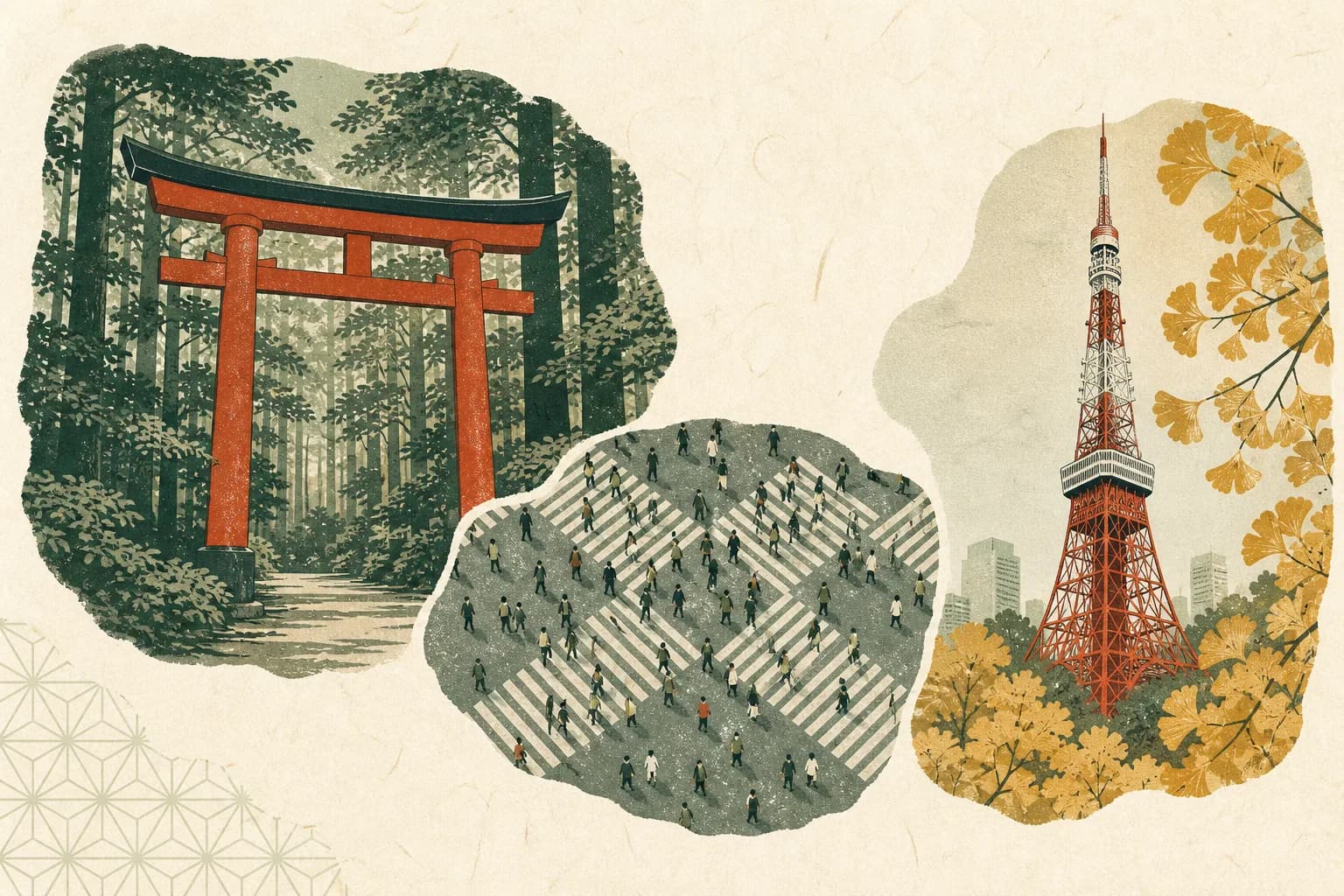
The venue sits in Omotesando, between Harajuku, Aoyama, and Shibuya - one of the most walkable parts of the city. Give yourself a day either side of the event if you can.
Within walking distance of the venue
- Meiji JinguA Shinto shrine set in a forest of a hundred thousand donated trees, a few minutes from Harajuku Station. The walk in under the great torii gates is the quietest place you will find this close to central Tokyo.
- Omotesando HillsThe architectural centerpiece of the Omotesando boulevard, built around a long internal spiral ramp. Worth stepping inside even if you are not shopping.
- Takeshita StreetThe narrow, crowded lane that made Harajuku famous for youth fashion. Loud, busy, and a complete contrast to the shrine ten minutes away.
- Tokyu Plaza Harajuku "Harakado"A recent addition at the Jingumae crossing, with a rooftop terrace that gives you an open view back down Omotesando.
- Nezu MuseumA collection of pre-modern Japanese and East Asian art in Aoyama, with a garden behind it that most visitors do not expect to find there.
- Yoyogi ParkA large open park next to Meiji Jingu, and the easiest place nearby to sit down for half an hour. Busiest and most entertaining on weekends.
- Shibuya Scramble CrossingThe intersection outside Shibuya Station that appears in every film set in Tokyo. Best after dark, and best watched from a window above it.
- SHIBUYA SKYAn open-air observation deck on top of the Shibuya Scramble Square tower, looking down on the crossing and out toward Mount Fuji on clear days. Tickets are usually booked in advance.
Worth the trip across town
- Senso-ji and NakamiseTokyo's oldest temple, in Asakusa, approached along a covered street of small shops selling snacks and souvenirs. Early morning is far calmer than the middle of the day.
- Tokyo SkytreeThe tallest structure in Japan, with observation decks and a large shopping complex at its base. A short walk or one stop from Asakusa, so the two pair naturally.
- Tokyo TowerThe older, red-and-white broadcasting tower, and still the more affectionately regarded of the two. Particularly good at night.
- Shinjuku GyoenA large garden combining Japanese, English, and French landscape styles, and one of the best places in the city for autumn colors in November.
- Tsukiji Outer MarketThe streets of food stalls and knife shops that remain where the old fish market stood. Go in the morning, and go hungry.
- Imperial Palace and Tokyo Station MarunouchiThe palace grounds and their moats sit directly opposite the restored red-brick facade of Tokyo Station. An easy hour of walking between the two.
Eating near the venue
- Vegan Bistro JangaraVeganIn Harajuku, a few minutes from the venue. A vegan take on ramen and Japanese comfort food, from a long-established ramen family.
- Vegan Sushi TokyoVeganSushiPlant-based sushi in Jinnan, Shibuya - the same techniques and presentation, entirely without fish.
- Shibuya Sushi MatsumotoSushiA counter sushi restaurant on Dogenzaka in Shibuya. Lunch is generally easier to get into than dinner.
Eating further afield
- Tempura Shinjuku Tsunahachi TsunohazuanTempuraTempura fried in front of you at the counter, from a Shinjuku restaurant that has been doing this since the 1920s.
- Sushi AomiSushiAn omakase sushi counter in Nishi-Shinjuku, where you leave the choice to the chef. Reservations are essentially required.
- Healthy Dining ALMAgrandeGluten freeA Shinjuku restaurant that accommodates gluten-free and other dietary requirements. Tell them what you need when you book.
- Gluten Free T's KitchenGluten freeIn Roppongi, and entirely gluten-free across the whole menu rather than on request - which is rare in Tokyo.
- Yakiniku Miyabi RoppongiYakinikuJapanese barbecue, where you grill the meat yourself at the table. A good choice for a group.
- Teppanyaki & Charcoal Grill SaitoTeppanyakiTeppanyaki in Roppongi, cooked on the iron plate in front of you.
- Shabu-shabu Seryna HontenShabu-shabuKobe beef shabu-shabu in Roppongi - thin slices cooked briefly in broth at your table.
A few notes on eating out: popular restaurants fill up well in advance, and asking your hotel concierge to book is by far the most reliable route, especially where no English-language booking page exists. If you are vegan, gluten-free, halal, or have allergies, confirm when you reserve rather than on arrival - kitchens will usually accommodate you if given notice. And do not overlook convenience stores: the food is genuinely good, and available at any hour.
Shopping and souvenirs
- Around the venue
- Omotesando and Aoyama are known for design-led select shops, homeware, and stationery; Harajuku for streetwear and small independent labels. Almost all of it is within walking distance of the venue.
- Tax-free shopping
- Consumption tax is 10 percent. Shops displaying a Tax-free sign can deduct it on qualifying purchases if you show your passport at the time of payment, so carry it with you if you plan to shop.
CBD shops
Coming soon. We will list shops registered as JIHE Community Partners as they join.
Appendix
Glossary
- BUSINESS DAY
- November 13 (Fri), aimed at business visitors and meetings.
- COMMUNITY DAY
- November 14 (Sat), open to everyone, with retail sales.
- CannaCon
- The name of the JIHE 2026 conference. Sessions by international speakers take place within it.
- AIHF
- The Asia International Hemp Federation, which holds its International Consultation the day before the expo.
- COA
- A certificate of analysis: a third-party laboratory report on what a CBD product actually contains.
- IC card
- A rechargeable card such as Suica or PASMO, tapped at ticket gates and accepted in many shops.
- TBA
- Not yet confirmed. We update this page as soon as each item is settled.
Change log
August 31, 2026
First edition published.
August 31, 2026
Refocused on international visitors; expanded the sections on reaching Tokyo, visa invitation letters, and exploring the city.
September 1, 2026
Redesigned the layout for readability.
September 1, 2026
Added a Google Maps link for the venue, clearer event dates, map links for the stations reachable without changing trains, and a list of reasonable hotel chains.
September 1, 2026
Added illustrations to each chapter.
September 2, 2026
Added a "For Speakers, Exhibitors & Partners" section linking to the Speaker Guide and the Participant Guide.
September 2, 2026
Noted in the "Getting there" chapter that there is no parking at the venue, and that we recommend public transport or a taxi.
September 9, 2026
Removed the "For Speakers, Exhibitors & Partners" section. The dedicated guides continue to link back to this page.
Anything unclear? Just ask.
If something is not covered here, or you are unsure how to handle it, please get in touch - in English is perfectly fine. During the event, the help desk at the 1F reception can help too.
Contact info@asabis.co.jp